
Quite a few of our teachers have experienced a different education system in other countries. It can be enlightening and fascinating in many ways and is a hugely valuable opportunity.
Here we have asked Lucy, one of our teachers, to share her memories and insights on her time spent teaching in Russia.
Q: Which countries have you worked in?
A: I worked in St Petersburg, Western Russia in an international Christian school.
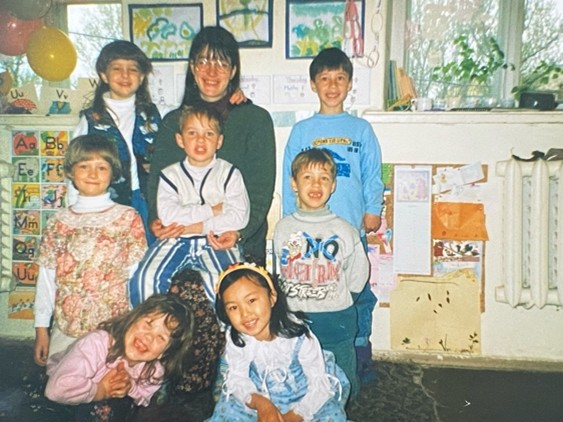
It was an American school but children from every nation were welcome to attend.
These included children from US, Russia, Korea, Hong Kong, Germany and Poland.
Tuition was a full US Christian primary curriculum taught in English.
Parents paid to attend. I taught Kindergarten and Grade one which is equivalent age to Year One and Year Two, but I also taught a 4 year old who in America would have been in a Pre Kindergarten class.
Q: When were you in Russia and for how long ?
A: I was in Russia from 1995 and spent 2 years there. It was during the aftermath of glasnost and perestroika when Russia was transitioning to a more capitalist model.
It was an exciting time for Russians with different Western products becoming available, though it could still take hours of scouring shops and market for cooking ingredients.
Money from advertising poured into the cities for improvements to transport.
Q:In which ways was the educational system similar to ours?
A:The main system in my school was American Christian as it was a school with pupil fees.
Like Britain, they had a reading scheme with different levels and this was quite phonic based plus sight or high frequency words.
We were expected to cover all the subjects and children also had separate Russian lessons to help them assimilate.
We had a PE coach and a music teacher for those lessons and we regularly took the children on trips to enrich their learning: to the zoo, the puppet theatre, swimming and to the countryside palaces.
There was a huge emphasis on Bible teaching ( we did 3 lessons a week!) and the children had “chapel” every morning which was like our assembly.
Teachers had regular in service days and training on managing behaviour, ICT and using the newly adopted RE curriculum.
Q: In which ways was the educational system different to ours?
A:The American system at the time was more prescribed than the British curriculum.
Even in the younger grades there were textbooks for each subject:
Geography might be a photo of a landscape with some simple questions underneath.
Science might be a picture of a fox with a taught unit followed by similar questions.
Children worked through a heavy glossy published English book with bright colours and pictures for each grade which their parents bought. The children did both reading and writing in this book. If the grade was not passed they would stay in that class and repeat until it was.
The American teachers were intrigued by my cross curricular topic- based and practical approach using real objects as starting points to build on learning.
Some teachers were used to working in schools across the world that still used corporal punishment as a discipline and I remember a huge debate with those of us from Europe who felt the idea was abhorrent.
Children who did not speak any English were initially placed in my class whatever age they were until their English improved. They sometimes found this very degrading and I found it counter productive.
I found the parents in the main to be much more supportive of the staff and of education in general. What the teacher said was ‘law’ and homework was enforced strictly at home.
An intriguing thing to me as a British teacher was the popularity of inviting teacher home to tea!
I visited every child’s house at least once each year and it was fascinating to learn about unfamiliar cultural foods and expectations of children. Some even invited me on days out with their children to museums, different cities and to picnics in the country; and it was all totally socially acceptable.
As part of my time in Russia I visited local Russian schools and also worked across the corridor from one. Russian schools at the time were very stern places with strict rules in the classroom.
* Children sat in rows taking direct instruction from the teacher.
*Lots of chanting, memorisation of facts and performance of poetry. The latter was designed to teach correct Russian intonation of words and phrases.
*In younger classes, folk stories, songs and traditions were a highly valued part of the curriculum.
* I would say higher standards were expected from Russian children with an emphasis on critical marking, competition, awards, pitting children against each other, marking down to encourage more effort and a tremendous amount of homework on top of extra curricular ballet, sport or other language lessons. They definitely saw the American system as children too ‘soft’.

Q:What were some of your most memorable moments teaching in Russia?
* Scrubbing the school in August ready for classes
* Herding the entire school onto and off the underground on trips!
* Snow on the ground October- May
*Getting ready for playtime in -28c. 20 mins to get dressed in outdoor clothes and 20 minutes to get undressed after!
* Arriving one day to find a whole dead cow in the playground!!
* Only being light in winter between hours of 10 and 2pm
* Only being dark in summer between 12 and 3am
* Going to the ballet at the Marinski theatre and watching a famous prima ballerina in her 70s dance the Dying Swan routine.
* Walking on the frozen sea to watch ice fishing
* The speed at which younger children learned English when that was their only shared language!
* The joy of seeing grass finally appearing in May
* How warm 0c feels after -28c!
* A special moment visiting a monastery and listening to church bells circa 1,000 AD
* The love and care I received from my Russian landlady and her children which was second to none!
* The Easter eve service which involved midnight candlelit circling of the outside of a church
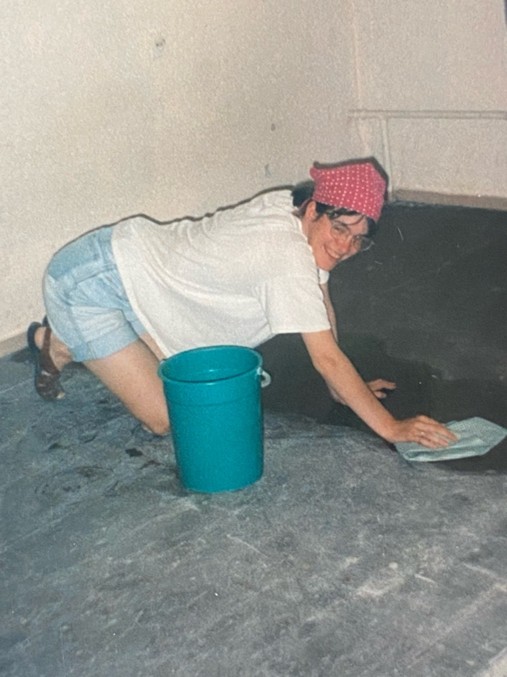
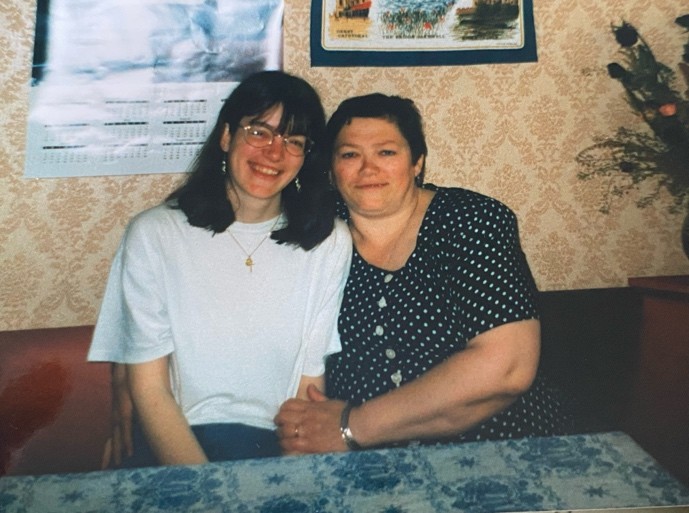
This is Lucy scrubbing her
classroom floor and with her
landlady.
4.What did you gain from a range of experiences abroad that helped you with your teaching back in the UK?
*Working with children that had English as their second or third or fourth! Language.
* Working with children who had often moved countries a lot and adults of many different backgrounds and cultures
* Confidence – not many people go to live in a country where they don’t know a soul and don’t speak the language!
* Knowledge that there are many ways to educate children and there is value in each different method. There is more than one way to boil an egg!
* How to manage adults in an educational and recreational setting. I also planned and ran the summer kids childcare programme for the charity I worked for, at a time when email was in its infancy!
I was able to share a lot of my good practice with colleagues and younger teachers on my return to England.
I realised how very important it to get to know a child’s home life and build relationships with the parents and carers.
Are there any countries you would still like to teach in… on your wishlist?
I think it would be very interesting to be a supply teacher doing short term posts in different countries. Yes, this is actually a thing if you work for certain charities! I also think being an itinerant teacher in the Philippines would be interesting. The teachers go by boat monthly to different islands to help families with their home schooling!
Finland also sounds a good place for teachers, with more emphasis on children’s emotional well being and lots of practical education outdoors, and less emphasis on individual exams and tests.
Blog written by Lucy Hunter & Jo Gotheridge 23 .12.25

This is such an interesting read! Thanks for sharing. I loved hearing about the Russian education system. Fascinating.
I know- I have never taught abroad so was very interested to get perspectives from teachers who have experienced other educational systems.